Navigation  
 
     HOME
 
  
HISTORY
   MEMBERS
 
  GALLERY
 
  TRAINING
 
  APPARATUS
 
  FIRE PREVENTION
 
  EXPLORER POST
   FUNDRAISERS
 
  AUXILIARY
 
  LINKS
   MEMBERS ONLY
   GUESTBOOK
 
  CONTACT US
  From the Chief  


Click here for a message
from the chief.

  Contact Information  
   
  Emergency: Dial 9-1-1

Department Address:
   W6566 State Hwy 144
   Random Lake, WI 53075
Mailing Address:
   Todd Stange, Fire Chief
   N518 State Highway 28
   Random Lake, WI 53075
   (920) 994-8109
Business Phone:
  
(920) 994-9421
Email Address:
   silvercreekfd@gmail.com


  2008 Fire Prevention  


The National Fire Prevention Association announced that the theme for Fire Prevention Week 2008 will be "It's Fire Prevention Week - Prevent Home Fires!"  Start planning your Fire Prevention Week activities now.

  Fire Prevention Week History  


Fire Prevention Week started to commemorate the Great Chicago Fire in October of 1871. The Great Chicago Fire killed more than 250 people, left 100,000 homeless, destroyed more than 17,400 structures, and burned more than 2,000 acres.  United States President Calvin Coolidge proclaimed the first National Prevention week in 1925.  President Coolidge noted that some 15,000 lives were lost in the United States alone during the previous year. 

"This waste results from the conditions which justify a sense of shame and horror; for the greater part of it could and ought to be prevented... It is highly desirable that every effort be made to reform the conditions which have made possible so vast a destruction of the national wealth".

-President Calvin Coolidge

The National Fire Protection Association continues today to make National Fire Prevention Week a priority and counts on the participation of tens of thousands of fire and safety personnel to reduce the risk of fire and its toll on society.  Fire Prevention week has historically been observed beginning on the first Sunday in October and ending the following Sunday.

  For the Kids  


"Dan Doofus"

Safety in the Kitchen
۰ Remind grown-ups to stay in the kitchen when cooking. Keep things that can burn (potholders, towels, and paper) away from the stove.
۰ Stay three feet away from the stove when a grown-up is cooking.

Electrical Check-up
۰ Help grown-ups check electrical cords to make sure they are not damaged.

Heating Reminders
۰ Remind grown-ups to keep space heaters 3 feet from anything that can burn.
۰ Grown-ups should always turn off space heaters every time they leave the room and before going to bed.
۰ Remind grown-ups never to use an oven to heat your home.

Match and Lighter Safety

۰ Tell a grown-up if you find matches or lighters
Grown-ups should keep matches and lighters in a locked cabinet.
Candle Caution
۰ Remind grown-ups to put out lit candles when they leave a room.
۰ Stay 3 feet away from burning candles.

Safety Smart Grown-up Reminders
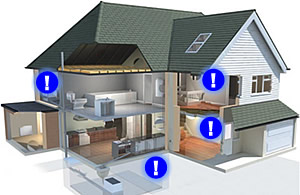
۰ Install smoke alarms on every level of your home, inside each bedroom and outside each sleeping area.
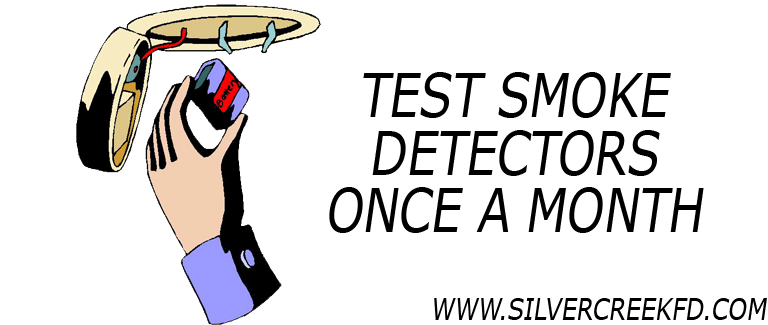
۰ Test smoke alarms once a month.
۰ Replace smoke alarms every 10 years.
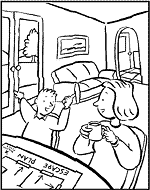
۰ Make a home fire escape plan with your family.
۰ Find two ways out of every room and an outside meeting place.
۰ Know the emergency number for your fire department.
۰ Practice your escape plan twice a year.
۰ When the smoke alarm sounds, get out and stay out!


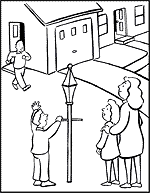
Click picture above


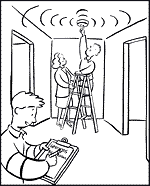
Click picture above

  For the Family  


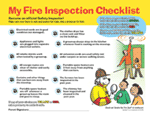
My Fire Inspection Checklist
Click picture above

Home Fire Escape Plan

Click picture above

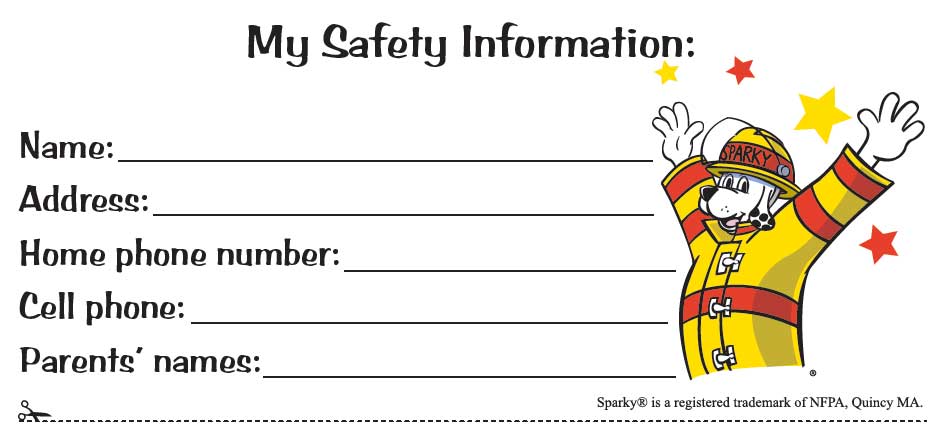
My Safety Information

Click picture above
  For the Adults  
   
 
Cooking with Care
۰ Stay in the kitchen when you are frying, grilling, or broiling food. If you leave the kitchen for even a short period time, turn off the stove.
۰ Keep anything that can catch fire – potholders, oven mitts, wooden utensils, paper or plastic bags – away form your stovetop.
۰ Wear short, close fitting or tightly rolled sleeves when cooking. Loose clothing can dangle onto stove burners and catch fire.
۰ Always keep an oven mitt and lid handy. If a small fire starts in a pan on the stove, put on the oven mitt and smother the flames by carefully sliding the lid over the pan. Turn off the burner. Don’t remove the lid until it is completely cool.

Everyday Electrical Safety
۰ Keep lamps, light fixtures, and light bulbs away from anything that can burn, such as lamp shades, bedding, curtains, and clothing.
۰ Replace cracked and damaged electrical cords.
۰ Use extension cords for temporary wiring only. Consider having additional circuits or receptacles added by a qualified electrician.
۰ Homes with young children should have tamper-resistant electrical receptacles.
۰ Call a qualified electrician or landlord if you have recurring problems with blowing fuses or tripping circuit breakers, discolored or warm wall outlets, flickering lights or a burning or rubbery smell coming from an appliance.

Healthy Heating
۰ Install and maintain carbon monoxide alarms to avoid risk of carbon monoxide poisoning.
۰ Maintain heating equipment and chimneys by having them cleaned and inspected every year by a qualified professional.
۰ Keep all things that can burn, such as paper, bedding or furniture, at least 3 feet away form heating equipment.
۰ Turn portable space heaters off when you go to bed or leave the room.
۰ An oven should not be used to heat a home.

 
Strike Out Smoking-materials Fires
۰ If you smoke, choose fire-safe cigarettes if they are available in your area.
۰ If you smoke, smoke outside.
۰ Wherever you smoke, use deep, sturdy ashtrays.
۰ Never smoke in a home where oxygen is used.
۰ Keep matches and lighters up high in a locked cabinet, out of the reach of children.

Candle with Caution
۰ Keep candles at least 12 inches form anything that can burn.
۰ Use sturdy, safe candleholders.
۰ Never leave a burning candle unattended. Blow out candles when you leave a room.
۰ Avoid using candles in bedrooms and sleeping areas.
۰ Use flashlights for emergency lighting.

Safety 101
۰ Install smoke alarms in every bedroom, outside each sleeping area and on every level of the home. For the best protection, interconnect all smoke alarms throughout the home. When one sounds, they all sound.
۰ Test smoke alarms at least once a month using the test button.
۰ Replace smoke alarms every 10 years.
۰ Make sure everyone can hear the sound of the smoke alarms.
۰ Have a home fire escape plan. Know at least two ways out of every room, if possible, and a meeting place outside. Practice your escape plan twice a year.
۰ When the smoke alarm sounds, get out and stay out.
۰ If you are building or remodeling your home, consider a residential fire sprinkler system.
  Home Fire Quick Facts  
   
 
Cooking
۰ Cooking fires are the #1 of home fires and home fire injuries.
۰ In 2005, cooking was involved in 146,400 reported home fires resulting in 480 deaths, 4,690 injuries, and $876 million in property damage.
۰ The majority of home fires – 40% – start in the kitchen.
۰ Unattended cooking is the leading factor contributing to ignition in home cooking fires.
۰ More than half of all cooking fire injuries occurred when people tried to fight the fire themselves.
۰ Most home cooking fires (67%) in 2005 started with the range or stove.
۰ Electric ranges or stoves have a higher risk of fires, deaths, injuries and property damage, compared to gas ranges or stoves.
Electrical
۰ In 2005, electrical distribution and lighting equipment were involved in an estimated 20,900 home fires resulting in 500 deaths and 1,100 injuries, and $862 million property.
۰ Lamps, light fixtures, and light bulbs accounted for the largest share of 2002-2005 non-confined fires among major types of electrical distribution equipment, while cords and plugs accounted for the largest share of civilian fire deaths.
۰ Extension cord fires outnumbered fires beginning with attached or unattached power cords by more than two-to-one.
۰ Cords and plugs were involved in 12% of the 2002-2005 home electrical distribution and lighting equipment fires, but roughly two-fifths (39%) of associated civilian deaths.
Smoking Materials
۰ Smoking materials (i.e., cigarettes, cigars, pipes, etc.) are the leading cause of fire deaths in the United States.
۰ Roughly 25% of fire deaths in 2002-2005 was attributed to smoking materials.

۰ In 2002-2005, there were an estimated 82,400 smoking-material fires per year in the United States causing caused 800 deaths and 1,660 injuries.
۰ Older adults are at the highest risk of death or injury from smoking-material fires even though they are less likely to smoke than younger adults.
۰ Mattresses & bedding are the most common material first ignited in home smoking-material fire deaths.
Candles
۰ In 2005, 15,600 home fires were started by candles resulting in an 150 deaths, 1,270 injuries and property loss of $539 million.
۰ Despite declining 8% from 2004 to 2005, more than twice as many were reported in 2005 as in 1990.

۰ Candle fires accounted for an estimated 4% of all reported home fires in 2005.
۰ The top five days for home candle fires were Christmas, Christmas Eve, New Year’s Day, New Year’s Eve, and Halloween.
Home Fires
۰ In 2006, 396,000 home fires resulting in 2,580 deaths, 12,500 injuries, and $6.8 billion in damage.
۰ Home fires caused 80% of civilian deaths and 76% of injuries.

۰ Heating equipment and smoking are the leading causes of home fire deaths.
۰ January and December were the peak months for home fires and home fire deaths.
۰ More than 50% of all home fire deaths occurred between 11:00 p.m. and 7:00 a.m., but only 20% of home fires occur between these hours.
۰ Children under 5 and older adults face the highest risk of home fire death, but young adults face a higher risk of home fire injury.
Heating
۰ Heating fires are the second-leading cause of home fires.
۰ In 2005, heating equipment was involved in 62,200 home fires resulting in 670 deaths, 1,550 injuries, and $909 million in property damage.
۰ 44% of all home heating fires occurred in December, January and February.
۰ Heating equipment fires accounted for 16% of all reported home fires in 2005 (second behind cooking).
۰ Space heaters, excluding fireplaces, chimneys, and chimney connectors, were involved in 32% of the home heating fires but 73% of the deaths in 2005.
۰ Between 2002-2005, the leading factor contributing to home heating fires was heating equipment too close to things that can burn.
Smoke Alarms
۰ Working smoke alarms cut the risk of dying in reported home structure fires in half.
۰ A 2004, 96% of households had at least one smoke alarm; yet in 2000-2004, no smoke alarms were present/operated in 46% of home fires.
۰ Estimated 890 lives could be saved each year if all homes had working smoke alarms.
۰ 65% of reported home fire deaths in 2000-2004 resulted from fires in homes with no smoke alarms or no working smoke alarms.
۰ The fire death rate in homes with working smoke alarms is 51% less than the rate for homes without this protection.
۰ In 20% of homes equipped with at least one smoke alarm installed, not a single one was working.
۰ When smoke alarms fail it is most often because of missing, disconnected or dead batteries.
۰ Nuisance activations were the leading cause of disabled smoke alarms.

"Reproduced from NFPA's Fire Prevention Week Web site, www.firepreventionweek.org. ©2008 NFPA."

xhtml code
Site Designed by: Joe Huebner

Silver Creek Fire Department © 2008